
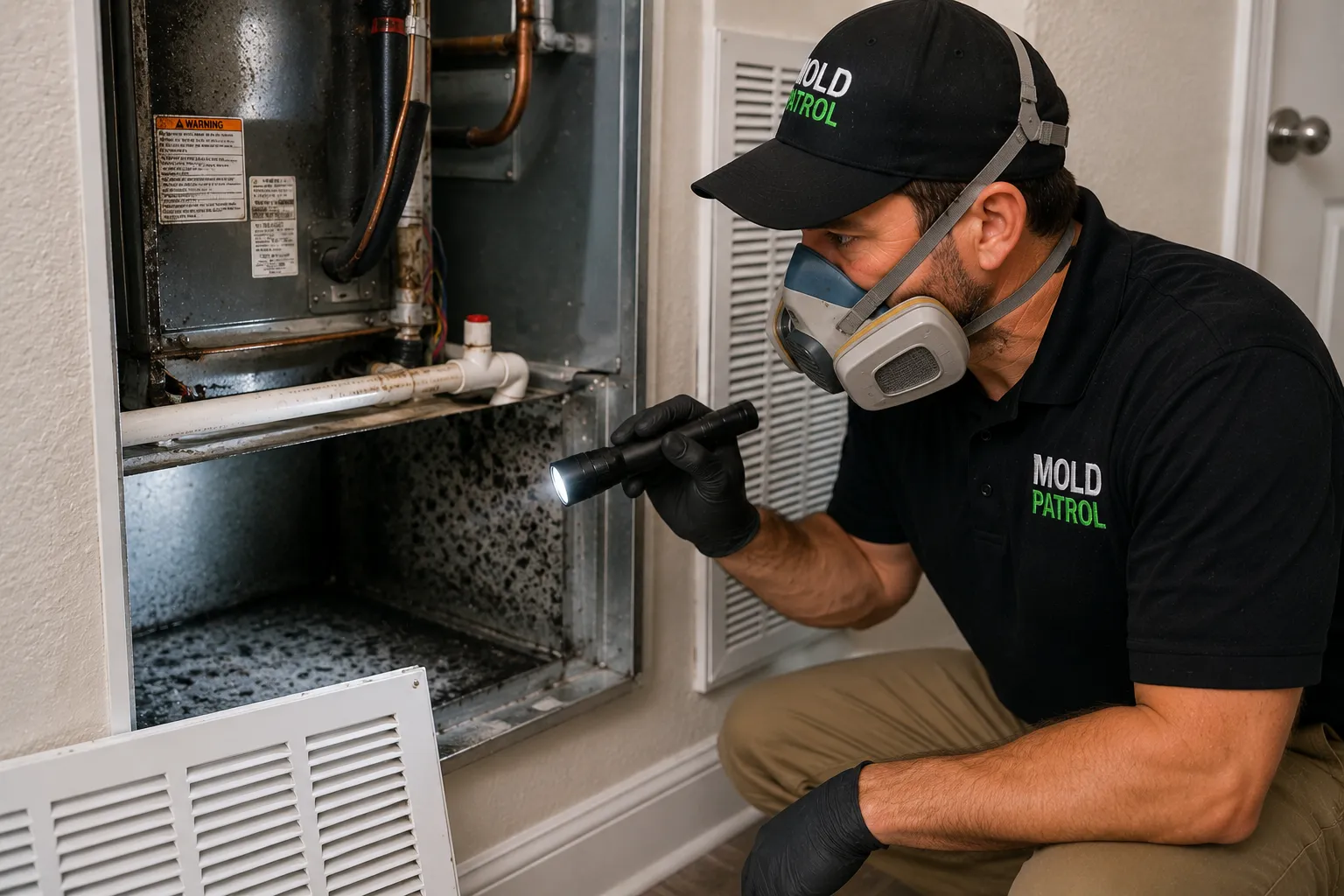
Can Your HVAC System Cause Moisture and Mold Problems?
Your air conditioner is running.
The house feels cool.
So everything must be working the way it should, right?
Not necessarily.
Your HVAC system doesn’t just control temperature. It also plays an important role in managing moisture inside your home. When something goes wrong with condensate drainage, humidity, airflow, or the environment surrounding the equipment, you can end up with more moisture than the building can comfortably handle.
And that matters when you’re trying to understand recurring mold.
The U.S. Environmental Protection Agency notes that one function of an HVAC system is to remove moisture from indoor air before that air is distributed through the building. (EPA)
So when Mold Patrol investigates HVAC moisture problems, the question isn’t simply whether the system still heats or cools.
It’s also: What’s happening with the water?
- How Your HVAC System Helps Manage Indoor Moisture
- What Mold Patrol Found in a Home With 74–78% Humidity
- Why an HVAC Moisture Problem May Affect More Than One Room
- Crawl Space Moisture and HVAC Equipment Can Intersect
- What Are the Warning Signs of an HVAC Moisture Problem?
- Does Condensation Around Ductwork Mean There’s Mold?
- Fix the Moisture Problem Before You Keep Treating the Mold
- Treat the HVAC System as Part of the Building
How Your HVAC System Helps Manage Indoor Moisture
Air-conditioning systems naturally create condensate.
As warm, humid air is cooled, some of the moisture in that air condenses into water. The HVAC system is designed to collect that water and move it away through the appropriate drain system.
When everything’s working properly, you probably never think about it.
When it isn’t, that water can become part of a larger moisture problem.
Brian Murphy, co-owner of Mold Patrol, recently encountered exactly that during an inspection.
“One of which, the condensation line was not draining correctly. So there was a buildup of moisture in the system.”
Brian Murphy
A blocked, damaged, or poorly draining condensate line doesn’t automatically mean there’s mold throughout the HVAC system.
What it does mean is that moisture isn’t being managed the way it should be.
The EPA recommends keeping air-conditioning drip pans clean and condensate drain lines unobstructed and flowing properly. It also recommends routinely checking HVAC systems because poorly draining condensate pans can retain water and potentially contribute to mold and bacterial growth. (EPA)
That’s an important distinction if you’re trying to understand why mold keeps coming back.
You may be cleaning what you can see while a moisture-producing condition associated with the HVAC system continues in the background.
If you’re seeing water around an air handler, a condensate line isn’t draining properly, or humidity stays unusually high even though the AC is running, don’t ignore it just because the house still feels cool.
What Mold Patrol Found in a Home With 74–78% Humidity
One of Brian’s recent inspections gives a useful real-world example of how an HVAC issue and high indoor humidity can connect.
Mold Patrol was inspecting a roughly 120-year-old farmhouse.
The homeowner already knew something wasn’t right, but he didn’t understand how extensive the moisture conditions had become.
Brian measured indoor relative humidity at approximately 74–78%.
“His relative humidity was reading between 74, 78%, which is very high.”
Brian Murphy
As part of the inspection, Brian used an inspection light to look at wooden furniture around the property from different angles.
He says mold growth could be seen across every piece he examined.
The next question was obvious:
Why was there so much moisture in the house?
The property had two HVAC systems. Brian found that the condensate line on one of them wasn’t draining correctly.
“There was a buildup of moisture in the system, which then, of course, impacted the other system.”
Brian Murphy
Brian explained that one unit served the downstairs and another served the upstairs, but those weren’t two completely isolated indoor environments.
“It’s shared air. So the air circulation throughout the home contains a higher level of moisture, which then caused elevated relative humidity.”
Brian Murphy
The condensate problem was therefore a contributing moisture condition within a house experiencing very high humidity.
For context, the EPA recommends keeping indoor relative humidity below 60% where possible and ideally between 30% and 50%. The agency notes that humidity or dampness in the air can itself provide enough moisture to support mold growth. (EPA)
You can read more about those numbers in our guide to understanding indoor relative humidity.
If you’re finding mold on furniture, belongings, walls, or other materials in several parts of the home at once, checking humidity and HVAC moisture management can help determine whether you’re dealing with more than one localized leak.
Why an HVAC Moisture Problem May Affect More Than One Room
Homes don’t always behave as a collection of sealed-off rooms.
Air moves.
Temperatures vary.
HVAC systems serve multiple spaces.
That’s why an excessive moisture condition associated with one part of the system may matter beyond the immediate area around the equipment.
Brian described that clearly in the farmhouse inspection:
“One unit serves the lower level, the other unit serves the upper level, but there’s no containment between the two levels. So it’s shared air.”
Brian Murphy
That doesn’t mean an HVAC issue automatically spreads mold throughout the whole house.
It means the moisture conditions in one part of a building can influence the wider indoor environment.
That distinction is important.
If you find mold in a bedroom, it’s tempting to concentrate exclusively on that bedroom.
Sometimes that’s exactly where the moisture source is.
But if several rooms have similar problems, indoor humidity is elevated, or the HVAC system has an unresolved drainage issue, it makes sense to step back and look at the building as a whole.
Brian’s inspection philosophy is built around that wider view:
“I’m looking for both. We’re not only looking for physical evidence of mold growth, but we’re looking for the conditions that are conducive to mold growth.”
Brian Murphy
That can also include hidden moisture and water damage that isn’t immediately obvious from the room where mold appeared.
If mold or dampness is showing up in several areas at once, don’t automatically treat each room as a separate problem. Look at what the HVAC system, humidity, and other building conditions are doing across the property.
Crawl Space Moisture and HVAC Equipment Can Intersect
There’s another reason HVAC and moisture often overlap in homes around Burlington and Greensboro.
A lot of the mechanical equipment is underneath the house.
When Brian was asked how HVAC systems are commonly arranged in the homes Mold Patrol encounters locally, he explained:
“Most systems will have an air handler under the house as well as the ductwork.”
Brian Murphy
Some homes have an indoor air handler with ductwork running through the ceiling, but Brian says the under-house configuration is common in his field experience.
That puts HVAC equipment and ductwork directly into the crawl-space environment.
If that environment has elevated humidity, condensation, plumbing leaks, a damaged vapor barrier, or poorly functioning dehumidification, it makes sense to consider both systems together.
A crawl space might have:
- excessive humidity;
- exposed soil;
- a damaged or incomplete vapor barrier;
- active plumbing leaks;
- condensation;
- a dehumidifier that isn’t working or draining correctly;
- damaged or disconnected ductwork.
That’s why our guides to crawl space moisture problems and crawl space vapor barriers are closely related to HVAC moisture.
Brian’s advice when inspecting a crawl space also includes checking that ductwork is still connected and that any dehumidification system is functioning and draining correctly.
If your air handler or ductwork runs through a damp crawl space, don’t evaluate the HVAC equipment without also looking at the moisture conditions surrounding it.
What Are the Warning Signs of an HVAC Moisture Problem?
You don’t need to understand every component of an HVAC system to notice that something deserves attention.
Brian says homeowners often first spot dark or black discoloration around HVAC registers or returns.
“A lot of times, homeowners will notice… dark spots or black spots around their registers, their HVAC registers, and sometimes around their returns.”
Brian Murphy
That discoloration doesn’t automatically prove what it is or where it came from.
But it’s worth investigating, particularly if it appears alongside other moisture clues.
Potential warning signs include:
- water collecting around an air handler;
- a condensate line that isn’t draining;
- recurring condensation around ductwork or vents;
- persistently high indoor humidity;
- musty odors when the HVAC system runs;
- visible growth around vents, returns, or equipment;
- discoloration that returns after cleaning;
- damp insulation near HVAC components.
Mold Patrol’s HVAC mold remediation and inspection service similarly identifies musty odors, visible growth around vents or returns, condensation around ducts, and recurring growth after cleaning as reasons an HVAC-related mold concern may deserve evaluation.
Brian says the moisture pattern itself can provide useful clues:
“Most of the time, what we’ll see is the excessive mold will be closest to the source of moisture.”
Brian Murphy
If several of these warning signs are happening together, find out what’s causing the moisture before assuming the answer is simply another round of duct cleaning.
Does Condensation Around Ductwork Mean There’s Mold?
No.
Condensation tells you there’s moisture. It doesn’t automatically prove that mold is present.
Condensation occurs when warm, humid air contacts a sufficiently cool surface and water vapor changes into liquid water.
The EPA specifically uses an uninsulated air-conditioning duct as an example of where condensation can develop and notes that condensation can be a sign of high humidity.
So if you’re repeatedly seeing water beads or wetness on ductwork, vents, or nearby surfaces, there’s a moisture condition worth understanding.
The question is what’s creating it.
Is indoor humidity excessively high?
Is insulation missing or damaged?
Is the surrounding crawl space damp?
Is airflow part of the problem?
Is condensation developing repeatedly and keeping materials wet?
Brian’s field observation is that higher moisture and humidity often correspond with heavier mold growth:
“The higher the moisture level or the higher the level of relative humidity, you’ll see higher concentrations of spore in these areas.”
Brian Murphy
That’s his professional observation, not a universal diagnostic rule. But it reinforces the same practical point: repeated wetness deserves attention before it becomes a larger problem.
For more on that relationship, read how relative humidity affects mold growth.
If ductwork or vents repeatedly collect condensation, don’t make wiping the water away your entire moisture-control plan. Find out why the surface keeps getting wet.
Fix the Moisture Problem Before You Keep Treating the Mold
Imagine cleaning discoloration from an HVAC register.
It looks fine.
A few weeks or months later, it’s back.
Cleaning the register again may change what you can see, but it doesn’t tell you why the area stayed damp enough for the problem to return.
The same applies to an air handler, ductwork, or HVAC-adjacent building materials.
Brian sums up the issue this way:
“Unless you’re correcting the conditions that cause it… it’s always going to come back.”
Brian Murphy
That doesn’t mean Mold Patrol is there to repair every mechanical HVAC fault.
There are situations where a condensate drain, air-conditioning equipment, airflow problem, or another mechanical issue may need to be repaired by a qualified HVAC contractor.
Mold Patrol’s role is centered on the mold, moisture, contamination, and environmental conditions.
Its HVAC remediation service looks at moisture and mold around air handlers, vents, returns, and ductwork, rather than treating visible growth as a standalone cosmetic issue.
That reflects Mold Patrol’s broader Root Cause Remediation philosophy: look at moisture, airflow, HVAC concerns, crawl spaces, materials, and how the building is behaving rather than putting a temporary patch on what’s visible.
If mold, condensation, or musty conditions keep returning around your HVAC system, Mold Patrol can help identify the moisture conditions involved and whether remediation, moisture control, or HVAC repair needs to be part of the next step.
Treat the HVAC System as Part of the Building
Your HVAC system doesn’t exist separately from the rest of your home.
It interacts with indoor air, temperature, humidity, condensate, crawl spaces, ductwork, and other building conditions.
When everything is working together properly, the system can help remove moisture from indoor air.
When condensate doesn’t drain correctly or the surrounding environment stays damp, that equation changes.
Brian’s farmhouse inspection is a good example: the visible mold was only part of the story. The investigation also had to consider humidity, shared air, HVAC equipment, and why so much moisture was present in the first place.
That’s the principle to remember.
Don’t just clean the mold.
Find out why the area stayed wet enough for mold to grow.
For homeowners, property managers, and commercial clients around Burlington, Greensboro, and nearby North Carolina communities, Mold Patrol can assess HVAC-related mold and moisture concerns and help make the next step clear.