
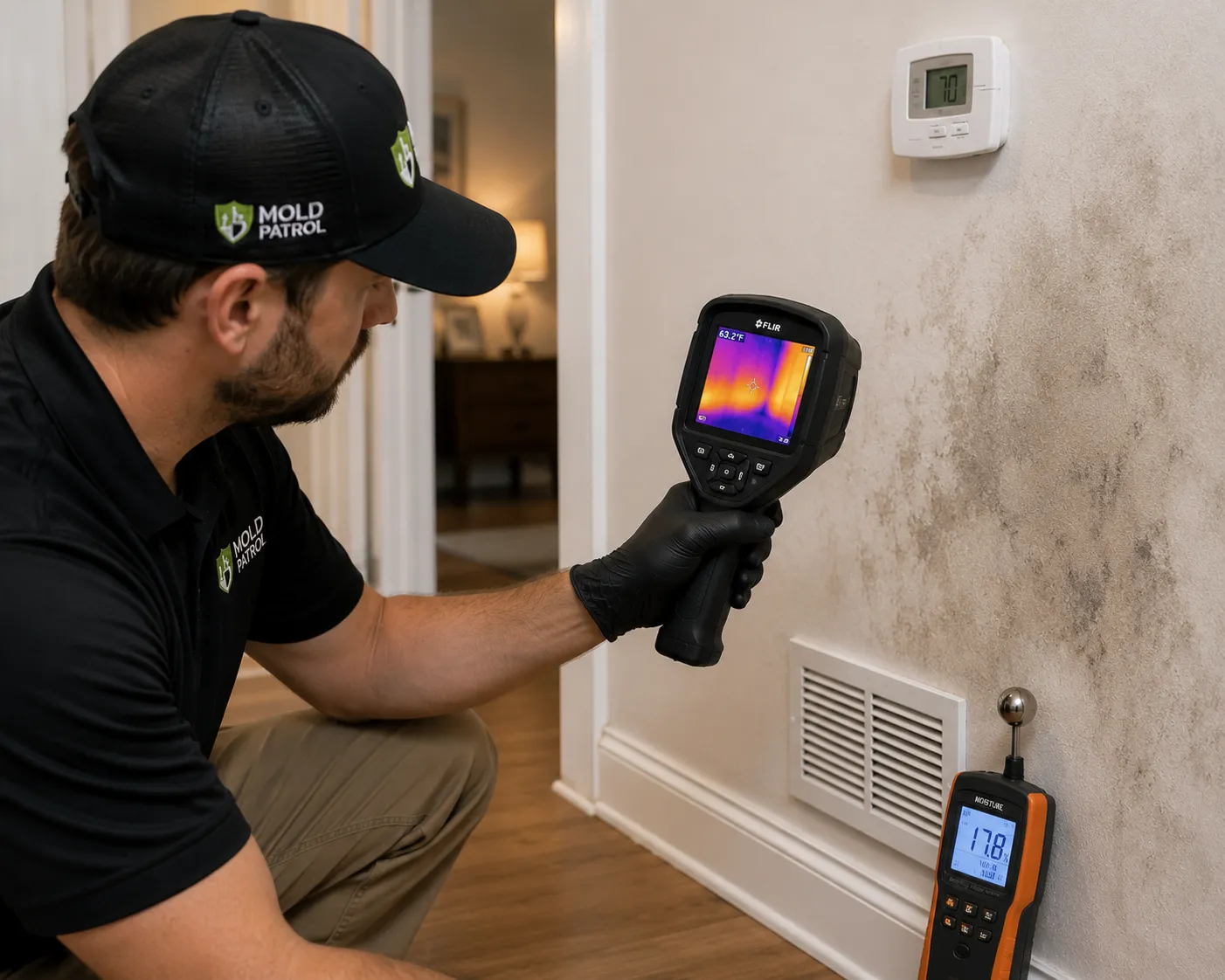
Can New Homes Have Mold? Moisture Problems in New Construction
You buy a brand-new home expecting to leave old-house problems behind.
Then you notice a musty smell.
Maybe there’s condensation that keeps appearing. Your indoor humidity seems unusually high. Or, even more confusingly, you find what looks like mold in a house that’s barely a few years old.
The obvious reaction is:
How can a new home already have mold?
According to Mold Patrol co-owner Brian Murphy, the age of the property doesn’t automatically protect it from moisture problems.
“The age of the home is not always a factor. We inspect new homes all the time that has issues.”
Brian Murphy
New construction materials may be new, but the basic conditions that allow mold growth haven’t changed.
If moisture is present and materials stay damp, a newer home can develop mold too.
- Why Can a Brand-New Home Develop Mold?
- Building a House and Building a Moisture-Resilient House Aren’t Quite the Same Thing
- Can Energy-Efficient Homes Be Too Tightly Sealed?
- High Humidity Can Affect a New Home Just Like an Old One
- HVAC Design and Drainage Still Matter in a New House
- What Should New Homeowners Watch For?
- Don’t Assume a Construction Defect Until You Find the Source
- New Doesn’t Mean Moisture-Proof
Why Can a Brand-New Home Develop Mold?
Mold doesn’t know how old your house is.
It responds to conditions.
That’s why Brian keeps coming back to the same point when he talks about remediation:
“The cause or the origin is, as always, going to be… moisture or elevated relative humidity or a water intrusion or a leak. You know, the mold is a byproduct.”
Brian Murphy
That principle applies whether a home was built 120 years ago or 12 months ago.
Mold in new construction can develop when moisture conditions exist long enough to support growth.
That moisture might be related to elevated indoor humidity, condensation, HVAC drainage, crawl-space conditions, water intrusion, plumbing, or another source.
Brian says that in Mold Patrol’s experience, they also encounter new homes where the problem appears connected to something that happened during construction.
“Most of those issues are caused from… a defect in the construction phase. However, some of it is just normal conditions.”
Brian Murphy
That’s an important distinction.
Brian isn’t saying most new houses are defective. He’s describing what Mold Patrol finds among the newer homes they’re called to inspect because there’s already a problem.
Sometimes there’s a construction-related issue.
Sometimes there isn’t.
Either way, the first question should be the same:
Where is the moisture coming from?
That’s also the central idea behind understanding why mold keeps coming back. Removing mold without understanding the conditions that allowed it to develop can leave you dealing with the same problem later.
If you’re seeing mold or persistent moisture in a newer home, don’t dismiss it because the property is only a few years old. Find out what condition is supplying the moisture.
Building a House and Building a Moisture-Resilient House Aren’t Quite the Same Thing
Brian made an interesting distinction during our interview.
Someone looking at a house purely from a construction perspective may not necessarily be looking for exactly the same things as someone investigating moisture and mold.
“If you’re looking at it strictly with construction eyes, you’re not going to see the potential problems… the areas that need attention, and you’re not going to have the right preventative measures in place to prevent… mold growth.”
Brian Murphy
That doesn’t mean builders don’t understand buildings.
It means moisture performance deserves specific attention of its own.
A home can look beautifully finished and still have a problem involving humidity, condensate drainage, a crawl space, water intrusion, or materials that became wet and didn’t dry as expected.
The EPA’s mold-prevention guidance takes a similarly whole-building approach. It emphasizes controlling roof and plumbing leaks, preventing condensation, managing indoor humidity, maintaining drainage, and keeping HVAC condensate systems functioning correctly.
That’s why visible finishes don’t tell you everything about how a new house is performing.
If a newer home develops repeated staining, odors, high humidity, or mold, the useful question isn’t simply whether construction is complete.
It’s whether the building is staying dry.
Previous construction-phase leaks or other concealed moisture can also be relevant, which is why our guide to hidden water damage is worth reading when there isn’t an obvious active source.
If a new home has recurring dampness or mold, look beyond whether the construction appears finished. The question is how the building is actually managing moisture.
Can Energy-Efficient Homes Be Too Tightly Sealed?
This is an area where the language needs to be precise.
Brian says that in his field experience, he sometimes encounters moisture problems in homes that have been heavily insulated or sealed.
“You’ll see that very frequently. People are over insulating… Spray foam insulation…”
Brian Murphy
He explains his concern this way:
“Over insulation basically means the home cannot breathe. So if it can’t breathe… you’re eliminating airflow, and that’s one of your primary defenses against moisture and elevating the relative humidity.”
Brian Murphy
The takeaway isn’t that spray foam, insulation, airtight construction, or energy efficiency causes mold.
In fact, properly designed air sealing can improve comfort, durability, and moisture control by reducing uncontrolled air leakage. U.S. Department of Energy guidance specifically describes tight air-sealed homes as a positive building strategy when the building envelope and mechanical systems are designed appropriately.
The more precise issue is that newer, high-performance homes behave differently.
DOE research notes that well-sealed and highly insulated homes have lower heating and cooling loads, while moisture loads can remain significant. That creates different HVAC and humidity-control requirements, particularly in humid climates.
In other words:
airtightness + insulation + HVAC + ventilation + humidity control all need to work together.
If one part of that system isn’t performing as intended, you may get a house that reaches the thermostat setting without managing indoor moisture as effectively as expected.
That’s a better way to understand Brian’s field observation.
You can read more about the moisture side of that relationship in our guide to understanding indoor relative humidity.
If moisture problems appeared shortly after moving into a tightly built home – or after major insulation or air-sealing work – look at humidity, HVAC performance, ventilation, and moisture management together rather than blaming one material automatically.
High Humidity Can Affect a New Home Just Like an Old One
A newer home can still have excessive indoor humidity.
Brian generally likes to see indoor relative humidity kept below roughly 55–58% for extended periods.
That’s his professional rule of thumb rather than a regulatory cutoff.
“Anything higher than that over a period of time, you’re looking at potential mold growth.”
Brian Murphy
Independent EPA guidance is similar.
The agency recommends keeping indoor relative humidity below 60% where possible and ideally between 30% and 50%. It also notes that humidity itself can provide enough moisture to support mold growth.
So if a new home is repeatedly sitting around 65%, 70%, or higher, being new doesn’t make that reading irrelevant.
The question becomes why.
Is the HVAC system removing enough moisture?
Is there a condensate issue?
Is ventilation contributing?
Is moisture entering from beneath the house?
Is condensation developing somewhere?
Was there a water event during or after construction?
Those are more useful questions than assuming high humidity must simply be normal because everything is new.
Our guide to how relative humidity affects mold growth goes deeper into what homeowners should monitor.
If your newer home consistently stays close to or above 60% relative humidity, treat that number as a clue and find out why the moisture isn’t being controlled.
HVAC Design and Drainage Still Matter in a New House
New HVAC equipment can still have moisture problems.
Brian recently inspected a home where a condensate line wasn’t draining correctly.
“There was a buildup of moisture in the system.”
Brian Murphy
That particular house wasn’t new, but the mechanical principle applies regardless of the building’s age.
When an air-conditioning system cools humid air, condensation forms. That water needs somewhere to go.
If the condensate system doesn’t drain correctly, moisture can build where it shouldn’t.
And in newer, well-sealed homes, HVAC design can become especially important.
DOE research into modern high-performance homes notes that highly insulated and tightly sealed buildings can have low cooling loads while still needing significant humidity control. Conventional equipment isn’t always optimized for that particular balance.
That doesn’t mean there’s necessarily anything wrong with the HVAC system because the home is efficient.
It means equipment sizing, runtime, ventilation, and dehumidification all influence how well moisture is controlled.
If you want to go deeper into this specific issue, read our guide to HVAC moisture problems.
If a newer home stays humid despite regular air-conditioning – or you see water or drainage problems around the equipment – don’t assume the HVAC must be fine simply because it’s new.
What Should New Homeowners Watch For?
You don’t need to become a building scientist just because you bought a new house.
But paying attention early can save a lot of frustration later.
Warning signs worth investigating include:
- persistently elevated indoor humidity;
- recurring condensation;
- musty odors that don’t have an obvious explanation;
- repeated mold or dark growth;
- water staining;
- HVAC condensate or drainage problems;
- damp crawl-space conditions;
- evidence of a construction-phase or post-construction leak;
- mold appearing on furniture or belongings in multiple rooms.
None of those signs proves that your home has a construction defect.
And they don’t necessarily prove hidden mold exists.
They tell you something about the moisture conditions deserves a closer look.
Brian’s advice is straightforward:
“Frequent inspections are key to keeping small problems, small problems.”
He points out that problems caught early can often be handled much more easily than conditions that continue unnoticed for years.
If something doesn’t seem right, a mold inspection and moisture assessment can help establish what’s actually happening before assumptions are made.
Document what you’re seeing and investigate it early. You don’t need to wait until a newer property feels “old enough” for moisture problems to make sense.
Don’t Assume a Construction Defect Until You Find the Source
There’s another side to this conversation.
Finding mold in a new home doesn’t automatically mean the builder did something wrong.
Brian himself makes that distinction.
Some of the newer-home problems Mold Patrol encounters appear related to construction-phase defects. Others, he says, result from more ordinary moisture conditions.
That’s why investigation needs to come before blame.
When Brian was asked whether he looks for mold or moisture during an inspection, his answer was simple:
“I’m looking for both.”
Brian Murphy
Mold Patrol looks for visible growth, but also elevated relative humidity, previous water damage, moisture intrusion, and leaks.
A sensible sequence is:
Find the moisture → understand the source → determine the extent → correct the condition → address mold where remediation is needed.
That gives the homeowner better information.
It also avoids making assumptions about builders, HVAC contractors, materials, or previous work before there’s evidence supporting those conclusions.
If you’re concerned about a newer property, a professional mold inspection can help clarify what conditions are actually present.
If mold appears in a newer home, Mold Patrol can investigate both the mold and the moisture conditions so you have better information before deciding what needs to happen next.
New Doesn’t Mean Moisture-Proof
A brand-new house can still develop mold.
Not because new construction is inherently problematic.
Because mold responds to moisture, not the date on the certificate of occupancy.
Construction details matter.
So do HVAC performance, humidity, airflow, crawl spaces, condensation, leaks, and ongoing maintenance.
Brian’s final message from the interview fits especially well here:
“The more that people are aware of the potential dangers of moisture intrusion and mold damage, the more effective and proactive they can be in trying to combat it.”
Brian Murphy
That’s the goal.
Not to make new homeowners worried about problems that may not exist.
It’s to recognize moisture clues early enough to do something useful with them.
For homeowners around Burlington, Greensboro, and nearby North Carolina communities, Mold Patrol can assess mold and moisture in newer homes, help identify the likely source, and explain the next step without assuming the answer before the inspection starts.