
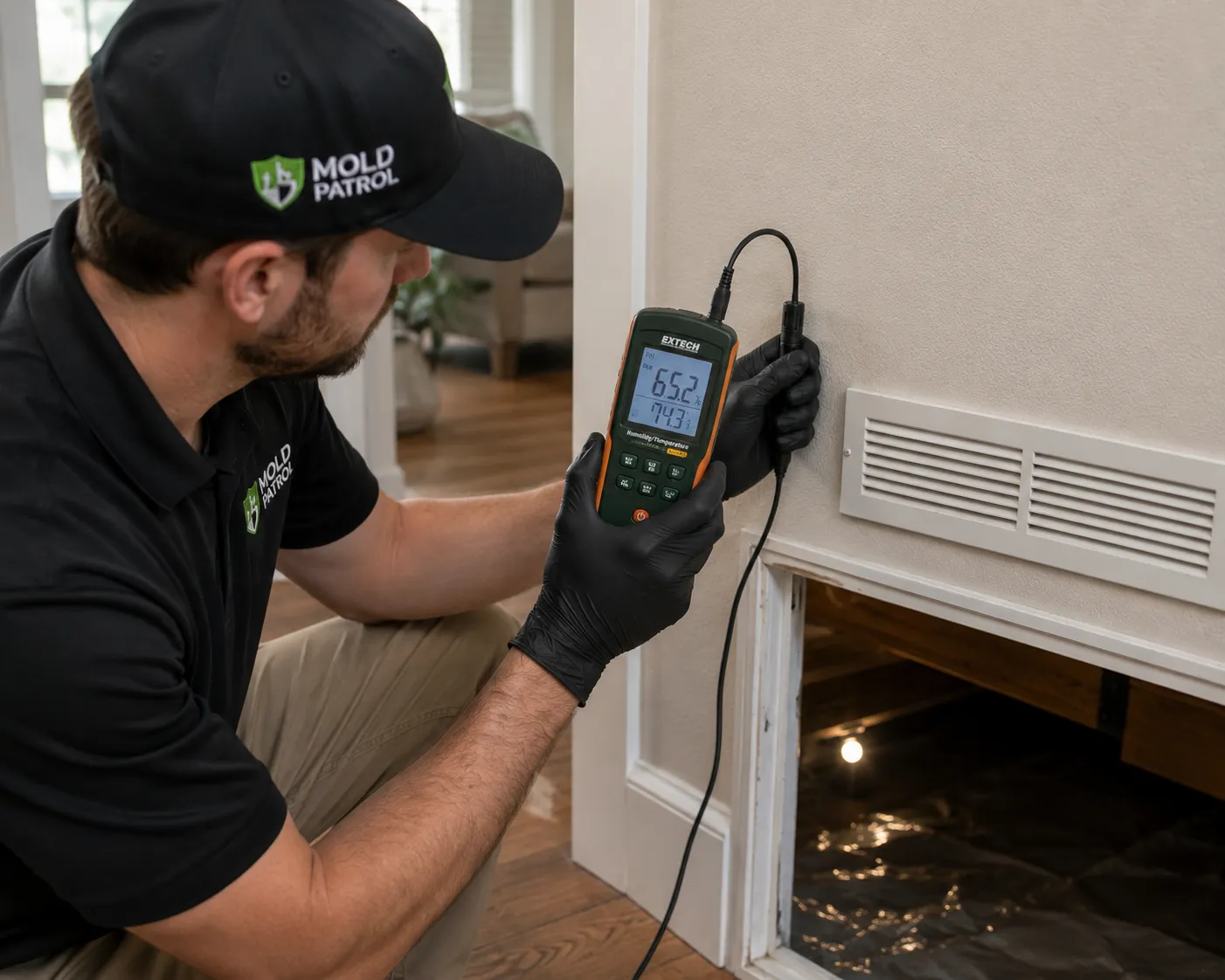
Relative Humidity
There’s no pipe leaking. Nothing’s dripping from the ceiling. The floor isn’t wet.
So why does the house still feel damp and musty?
Sometimes the moisture problem isn’t something you can see running down a wall. It’s in the air.
Relative humidity describes how much moisture is in the air compared with how much that air can hold at its current temperature. When indoor relative humidity stays elevated, building materials and belongings can remain damp enough to create conditions where mold is more likely to grow.
That’s why humidity is one of the things Mold Patrol pays attention to during moisture and mold investigations.
A humidity reading won’t tell you everything by itself. But it can be an important clue.
- What Relative Humidity Level Should Your Home Be?
- What High Relative Humidity Can Look Like in a Real Home
- Your HVAC System Can Be Part of the Humidity Problem
- Crawl Spaces and Basements Can Affect Indoor Humidity Too
- Can a House Be Too Tightly Sealed?
- Will a Dehumidifier Solve High Relative Humidity?
- How to Monitor Relative Humidity Without Obsessing Over It
- Treat the Humidity Reading as a Clue
What Relative Humidity Level Should Your Home Be?
Brian Murphy, co-owner of Mold Patrol, has a fairly simple rule of thumb when he’s assessing humidity inside a home.
“You generally want your relative humidity inside of your home not to exceed 55, 58%. Anything higher than that over a period of time, you’re looking at potential mold growth.”
Brian Murphy
That’s Brian’s field guidance rather than a regulatory cutoff. Humidity also changes naturally as temperatures, weather, occupancy, and daily activities change.
The bigger concern is when indoor relative humidity stays elevated for extended periods.
The U.S. Environmental Protection Agency recommends keeping indoor relative humidity below 60% where possible, and ideally between 30% and 50%. The EPA also notes that humidity or dampness in the air can provide enough moisture to support mold growth.
You can read the full EPA guidance on mold, moisture, and indoor humidity.
Brian says that in homes where moisture is being managed properly, he commonly expects readings to fall somewhere around the 50–60% range. But Mold Patrol also walks into homes reading 70% or higher.
One high reading doesn’t automatically mean you have a serious mold problem. What matters is the pattern.
If humidity rises after somebody showers and then drops again, that tells you something very different from a home that sits at 70% day after day.
That pattern can also help explain why mold keeps coming back even when you can’t find a traditional leak.
If your indoor humidity regularly stays near or above 60%, don’t just watch the number. Start asking why that moisture is remaining inside the home.
What High Relative Humidity Can Look Like in a Real Home
One of Brian’s recent inspections shows why humidity matters so much.
Mold Patrol was called to a roughly 120-year-old farmhouse. The homeowner knew there was a problem, but he didn’t realize how extensive the conditions had become.
Brian measured the home’s relative humidity between approximately 74% and 78%.
“His relative humidity was reading between 74, 78%, which is very high.”
Brian Murphy
During the inspection, Brian used an inspection light to examine pieces of wooden furniture from different angles.
He could see mold growth across every piece he checked.
This wasn’t simply a small patch of mold around one isolated leak. The house itself had a broader moisture problem.
That distinction matters.
When one pipe leaks beneath a sink, you may expect the heaviest moisture effects close to that pipe. When the air throughout a house contains excessive moisture, many different materials can be exposed to the same conditions.
That doesn’t mean every home with high humidity will develop mold across its furniture. It means persistent humidity can affect more than one small area at a time.
The age of the farmhouse wasn’t necessarily the deciding factor either.
Brian says Mold Patrol also finds moisture problems in newer homes. In those cases, issues can relate to construction defects, building conditions, or moisture-management measures that weren’t adequately considered.
So whether your home is 120 years old or relatively new, unexplained mold appearing in several areas is worth investigating.
Sometimes the answer is humidity. Sometimes it’s hidden water damage. Sometimes several issues are happening together.
If furniture, closets, walls, or other materials start developing mold in different areas of the home, checking relative humidity can help reveal whether you’re dealing with a broader moisture condition.
Your HVAC System Can Be Part of the Humidity Problem
In that farmhouse, Brian didn’t stop once he saw the humidity reading.
He wanted to know why it was so high.
The property had two HVAC systems. Mold Patrol found that a condensate line on one of them wasn’t draining correctly, allowing moisture to build up in the system.
Because the upper and lower levels of the house shared air, the moisture condition wasn’t neatly contained around one piece of equipment.
“The air circulation throughout the home contains a higher level of moisture, which then caused elevated relative humidity.”
Brian Murphy
An HVAC system doesn’t only change air temperature. Moisture management is also part of what properly operating air-conditioning equipment does.
The EPA notes that HVAC systems can remove moisture from indoor air before distributing it through a building. It also recommends keeping air-conditioning drip pans clean and drain lines unobstructed and flowing properly.
Signs worth paying attention to can include condensation around vents or ductwork, a condensate drain that isn’t flowing properly, unusual musty odors around the system, or humidity that remains high despite normal cooling.
None of those automatically proves you have HVAC mold.
But they’re clues worth following.
Mold Patrol’s HVAC mold remediation and inspection service looks at mold and moisture around HVAC equipment and ductwork rather than treating what’s visible without considering why it developed.
If relative humidity stays high and you’re also seeing HVAC condensation or drainage problems, find the cause before assuming a bigger dehumidifier will solve it.
Crawl Spaces and Basements Can Affect Indoor Humidity Too
The source of high humidity isn’t always in the room where you notice the problem.
Brian’s interview repeatedly comes back to looking at the whole property.
Crawl spaces may have exposed soil, inadequate vapor barriers, plumbing leaks, damaged moisture controls, or dehumidifiers that aren’t working properly. Basements may be affected by exterior drainage, plumbing, water heaters, HVAC condensate lines, or several sources at once.
That means persistent relative humidity inside the living area can sometimes be a clue pointing toward another part of the building.
For crawl spaces in particular, Brian describes moisture control as a combination of systems:
“You’ve gotta have your vapor barrier. You’ve gotta have something to handle the humidity, and you have to have something to help with airflow.”
Brian Murphy
The important point isn’t that every humid home has a crawl-space or basement problem.
It’s that moisture doesn’t respect the arbitrary boundaries we use when we think about rooms.
If you’re trying to understand persistent humidity, it can make sense to investigate crawl space moisture problems and the common causes of basement moisture alongside what’s happening upstairs.
If the living space stays humid even though individual rooms seem dry, look beyond those rooms. Crawl spaces, basements, HVAC systems, and other moisture sources may all deserve attention.
Can a House Be Too Tightly Sealed?
Energy efficiency is a good thing.
But insulation, air sealing, ventilation, and moisture management all need to work together.
Brian says he sometimes encounters homes where changes intended to make a property more energy efficient have also changed the way moisture and air move through the building.
His concern is particularly with situations where a home has been heavily insulated or sealed without enough consideration for airflow and humidity.
“Over insulation basically means the home cannot breathe. So if it can’t breathe… you’re eliminating airflow, and that’s one of your primary defenses against moisture and elevating the relative humidity.”
Brian Murphy
That shouldn’t be interpreted to mean that spray foam, insulation, or energy-efficient construction automatically causes mold.
A well-designed tighter home can manage moisture successfully.
Brian’s field point is that you can’t think about one building component in isolation. If you substantially change airflow or insulation, moisture management and ventilation need to be considered at the same time.
Condensation is another clue.
The EPA notes that condensation can indicate high humidity and can form when warm, humid air contacts a colder surface.
So if condensation, humidity, or recurring mold appeared after major insulation or air-sealing work, investigate how the building is now managing moisture rather than assuming one material is automatically to blame.
If humidity problems started after changes to insulation or air sealing, look at the building as a system – airflow, ventilation, temperature, and moisture all matter.
Will a Dehumidifier Solve High Relative Humidity?
A dehumidifier can absolutely help control moisture in the air.
But it can’t fix every reason that moisture is there.
A dehumidifier won’t repair a leaking HVAC condensate line.
It won’t stop water entering through a basement.
It won’t fix plumbing.
It won’t replace a failed crawl-space vapor barrier.
And it won’t remove existing mold contamination.
That’s why Brian’s broader message throughout the interview is so important: identify the source rather than treating only the symptom.
If relative humidity is high because moisture keeps entering the property, a dehumidifier may spend all day trying to keep up with a problem that remains active.
Mold Patrol takes the same approach with its dehumidification and moisture assessments.
Rather than treating a dehumidifier as a magic box, Mold Patrol looks at humidity alongside crawl spaces, basements, HVAC-adjacent areas, drainage, vapor barriers, leaks, and existing mold concerns before recommending the next step.
Sometimes dehumidification is exactly what the moisture-control plan needs.
Other times, something else has to happen first.
If your dehumidifier seems to run constantly or fills unusually quickly, don’t automatically buy a bigger one. Find out what moisture it’s being asked to remove.
How to Monitor Relative Humidity Without Obsessing Over It
You don’t need to spend your day staring at a humidity meter.
The goal is awareness, not anxiety.
A few practical habits can tell you a lot:
- Use a basic humidity monitor in areas you’re concerned about.
- Look for patterns over several days rather than reacting to one reading.
- Pay attention to condensation, dampness, or musty odors alongside the number.
- Note whether readings change when your HVAC runs or after heavy rain.
- Consider crawl-space, basement, or previous water issues if humidity stays elevated.
- Investigate persistent moisture rather than simply forcing the number down.
Brian’s prevention philosophy is simple:
“Frequent inspections are key to keeping small problems, small problems.”
Brian Murphy
He explains that catching moisture conditions early can make them easier and less expensive to address than problems that have continued unnoticed for years.
That’s also the thinking behind Mold Patrol’s professional moisture assessment: look at humidity readings alongside the property conditions that may be driving them.
If your humidity readings stay elevated and you can’t explain why, Mold Patrol can help assess the number in the context of the whole building rather than treating it in isolation.
Treat the Humidity Reading as a Clue
Relative humidity is useful because it can reveal a moisture condition before you necessarily see water pouring from the ceiling.
But the number isn’t the final diagnosis.
High humidity may point toward an HVAC drainage problem, a damp crawl space, basement moisture, condensation, water intrusion, or another source entirely.
The right approach is to measure the condition, find out what’s driving it, and correct the source rather than just chasing the number.
If you’re in Burlington, Greensboro, or a nearby North Carolina community and you’re concerned about high indoor humidity, recurring mold, or unexplained moisture, Mold Patrol can help investigate what’s happening and explain the right next step.