
Basement Moisture
You walk downstairs and notice the basement feels damp. Maybe there’s a musty smell that never quite goes away. Maybe you’ve found staining near a wall, condensation around mechanical equipment, or mold that seems to return after it’s been cleaned.
There’s a reason those conditions are there.
The harder part is figuring out exactly what that reason is.
Basement moisture is something Mold Patrol encounters regularly, but there isn’t one single explanation that fits every property.
“It’s very, very common. And the moisture comes from… several different areas.”
Brian Murphy
That distinction matters.
If the moisture is coming from a plumbing leak, you need to deal with the plumbing. If it’s exterior water intrusion, the answer may involve drainage. If an HVAC condensate line is leaking, treating the basement wall won’t fix the mechanical problem.
A lasting solution starts with finding out where the moisture is actually coming from.
- Where Does Basement Moisture Come From?
- Sometimes There’s More Than One Moisture Problem
- How Basement Moisture Creates Conditions for Mold
- The Moisture You Can’t See Can Be Just as Important
- Will a Dehumidifier Fix a Damp Basement?
- What a Lasting Basement Moisture Solution Looks Like
- Don’t Let One Fix Hide Another Problem
Where Does Basement Moisture Come From?
When Brian inspects basement moisture problems, he isn’t looking for one predetermined cause.
He’s looking at the building and following the evidence.
“With basements, we’ll see improper drainage… from outside the home. We see plumbing leaks. We see hot water heater leaks. We see condensation line leaks from the HVAC system.”
Brian Murphy
Each of those can introduce moisture in a different way.
Poor exterior drainage can allow water to collect around the structure instead of moving away from it. Plumbing connections can develop slow leaks. Water heaters can fail or begin leaking. HVAC systems produce condensation as part of normal operation, but a blocked, damaged, or disconnected condensate line can put that moisture somewhere it doesn’t belong.
Then there are situations where the source is less obvious.
A basement may feel humid even though nobody can see water coming in. Moisture may appear only after heavy rainfall. A leak may happen intermittently rather than constantly.
That’s why diagnosing basement moisture by looking only at the most obvious damp patch can send you in the wrong direction.
It also connects directly to the bigger question of why mold keeps coming back. If you clean the mold but leave the moisture source active, you haven’t changed the conditions that allowed the growth to develop.
If your basement stays damp, smells musty, or repeatedly develops staining, start by identifying the source instead of assuming a dehumidifier or surface treatment will solve everything.
Sometimes There’s More Than One Moisture Problem
This is where basement moisture can get frustrating.
You find a leak.
You repair it.
Naturally, you think the problem is solved.
And sometimes it is.
But Brian says Mold Patrol also sees properties where several sources are contributing at the same time.
“Sometimes it’s a combination of sources. So, again, you know, all of those have to be addressed because if you… address eight out of 10, those two that you don’t address will continue to bring moisture into the area and kind of undo the work that you’re doing.”
Brian Murphy
That’s an important point.
Imagine a basement with poor exterior drainage and a leaking HVAC condensate line.
Correcting the drainage is worthwhile. You’ve eliminated one legitimate source.
But if that condensate line continues leaking, the basement can still stay wet.
The reverse is also true. Repairing a pipe doesn’t stop water from entering because of a separate drainage issue.
So when basement moisture returns after something has already been repaired, it doesn’t necessarily mean the repair failed.
It may mean the repair addressed one part of a larger moisture problem.
That’s why Mold Patrol places so much emphasis on fixing the root cause of recurring mold.
As Brian has explained throughout his approach to remediation, mold is often the symptom. Moisture is the condition that needs to be understood and controlled.
If you’ve fixed one basement leak but the dampness, odor, or mold keeps coming back, don’t automatically repeat the same repair. Look for what else may still be bringing moisture into the space.
How Basement Moisture Creates Conditions for Mold
A basement doesn’t need several inches of standing water before moisture becomes a concern.
Building materials can remain damp after the obvious water disappears. Humidity can stay elevated. Water can get into drywall, framing, trim, flooring, insulation, stored contents, and other materials.
And when materials stay damp long enough, conditions can become more favorable for mold growth.
Brian explains the relationship simply:
“The cause or the origin is… moisture or elevated relative humidity or a water intrusion or a leak. You know, the mold is a byproduct.”
Brian Murphy
That’s why speed matters after a leak or water intrusion.
The U.S. Environmental Protection Agency recommends drying wet or damp materials within 24 to 48 hours where possible. According to the EPA, materials that are dried within that window will usually not develop mold growth.
Source: https://www.epa.gov/mold/brief-guide-mold-moisture-and-your-home
Some signs that basement moisture deserves a closer look include:
- persistent musty odors;
- recurring staining;
- damp drywall, trim, or other finishes;
- condensation on surfaces or mechanical equipment;
- peeling or bubbling finishes;
- visibly wet materials;
- elevated humidity;
- mold that reappears after cleaning.
None of those signs tells you the source by itself.
They tell you there’s something worth investigating.
If humidity appears to be part of the problem, our guide to how relative humidity affects mold growth explains why moisture in the air can matter even when you don’t see an active leak.
When basement moisture keeps materials damp, cleaning whatever mold you can see doesn’t necessarily change the environment that allowed it to grow.
If the basement has been wet or damp for an extended period, don’t judge the situation only by whether there’s still standing water. The affected materials and surrounding conditions matter too.
The Moisture You Can’t See Can Be Just as Important
One of the challenges with water intrusion is that where you notice the problem isn’t always where it started.
Water can move.
It can follow building materials, enter finished assemblies, travel around plumbing or mechanical systems, and affect areas that aren’t immediately visible.
That’s one reason Mold Patrol’s inspections don’t focus only on visible mold.
“We’re not only looking for physical evidence of mold growth, but we’re looking for the conditions that are conducive to mold growth such as elevated relative humidity, any evidence of previous water damage, moisture intrusions, leaks, anything along those lines.”
Brian Murphy
In a finished basement, that may mean looking more closely at areas around plumbing, HVAC equipment, previous water events, flooring, finished walls, or places where moisture has repeatedly appeared.
It’s important not to jump to conclusions.
A musty smell doesn’t prove there’s mold hidden inside a wall. Staining doesn’t automatically tell you exactly where water originated.
But those signs can justify further investigation.
That’s especially true when you keep fixing what’s visible and the same problem comes back.
Our guide to signs of hidden water damage goes deeper into what homeowners can look for when the source isn’t obvious.
With basement moisture, sometimes the clue you can see is only the end point of a problem happening somewhere else.
If your basement smells damp even when surfaces look dry, or staining keeps returning in the same area, it’s worth investigating instead of assuming the visible surface tells the whole story.
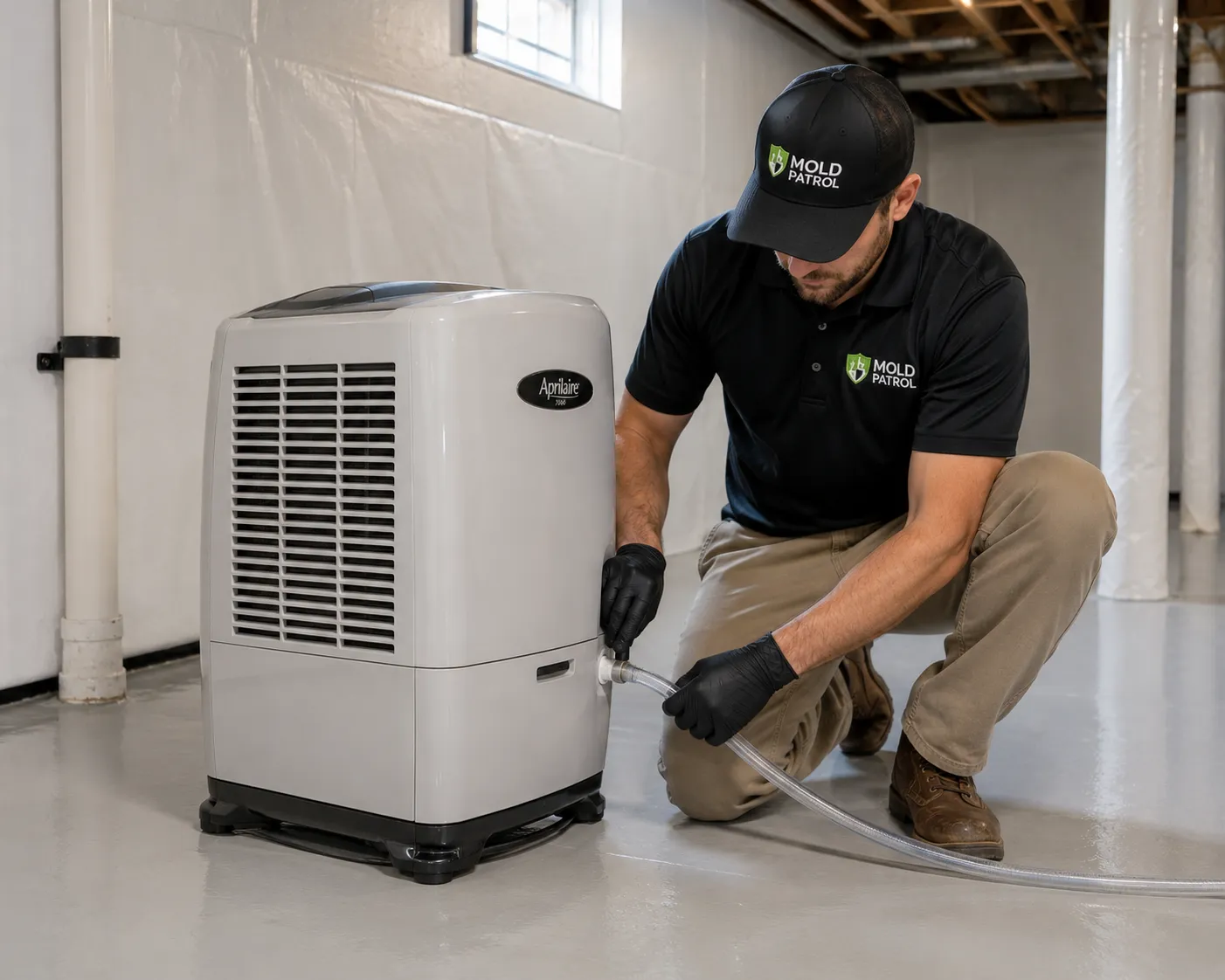
Will a Dehumidifier Fix a Damp Basement?
Sometimes a dehumidifier can be an important part of the solution.
But a dehumidifier isn’t a repair tool for every moisture source.
A dehumidifier removes moisture from the air.
It doesn’t repair a leaking pipe.
It doesn’t redirect rainwater away from the home.
It doesn’t fix a failed water heater.
And it doesn’t unblock a leaking or malfunctioning HVAC condensate line.
That distinction is important because it’s easy to put a dehumidifier in a damp basement, watch it collect water, and assume the machine is solving the source.
In reality, it may simply be trying to keep up with moisture that continues entering the space.
Brian’s position on basement problems is straightforward:
“All of those have to be addressed.”
Brian Murphy
That’s why dehumidification should be considered alongside the rest of the moisture picture.
Mold Patrol’s dehumidification and moisture assessment approach looks at humidity along with possible moisture sources, building conditions, and existing mold concerns rather than assuming a machine is automatically the answer.
If the main problem is elevated humidity, dehumidification may be very useful.
If there’s also an active leak, that leak still needs attention.
Understanding indoor relative humidity helps make that distinction clearer.
If your basement dehumidifier seems to run constantly but the space stays damp or musty, find out whether it’s controlling humidity – or just fighting an unresolved source of water.
What a Lasting Basement Moisture Solution Looks Like
There isn’t one universal basement-moisture package that every house needs.
That’s actually the point.
The solution should follow the problem.
A sensible process usually means identifying the active moisture sources first, correcting those sources, drying affected materials, determining whether mold remediation is needed, managing any remaining humidity, and then keeping an eye on the conditions afterward.
Brian supports homeowners being proactive, but he also knows where things can become complicated.
“I’m all for homeowners being proactive and trying to handle whatever they can themselves… [but] a lot of times, due to lack of overall knowledge or training in regards to mold and moisture issues, that’s not really something you wanna try to DIY.”
Brian Murphy
You can absolutely keep gutters clear, pay attention to plumbing, monitor humidity, look for staining, and respond quickly when something gets wet.
Those are useful habits.
Where things become more difficult is when there are several potential moisture sources, mold has already developed, finished materials are involved, or you simply can’t work out where the water is coming from.
That’s when finding the origin matters more than guessing at another fix.
As Brian puts it elsewhere when describing Mold Patrol’s approach:
“Finding the origin or the root cause of the situation is paramount, because otherwise you’re just putting a Band-Aid on a bullet wound.“
Brian Murphy
That principle sits at the center of Mold Patrol’s professional mold remediation work.
For homeowners and property managers needing mold remediation in Greensboro, that means looking at the contamination and the building conditions that allowed it to develop rather than simply treating the visible surface.
If basement mold or moisture keeps returning, Mold Patrol can help trace the conditions behind it so you know what needs fixing – and what doesn’t.
Don’t Let One Fix Hide Another Problem
Basement moisture can come from drainage, plumbing, mechanical systems, humidity, or several sources at once.
That doesn’t mean every damp basement is complicated.
It means you shouldn’t assume the first problem you find is automatically the only one.
Brian’s “eight out of ten” example captures the issue well: correcting most of the moisture sources still leaves a problem if the remaining ones continue adding water to the space.
The goal is a complete picture, not a temporary patch.
If you’re in Burlington, Greensboro, or a nearby North Carolina community and you’re dealing with a damp basement, recurring mold, persistent odors, or unexplained water intrusion, Mold Patrol can inspect the moisture and mold conditions and help you understand the right next step.