
Crawl Space Vapor Barriers: What They Do and How to Know If Yours Is Failing
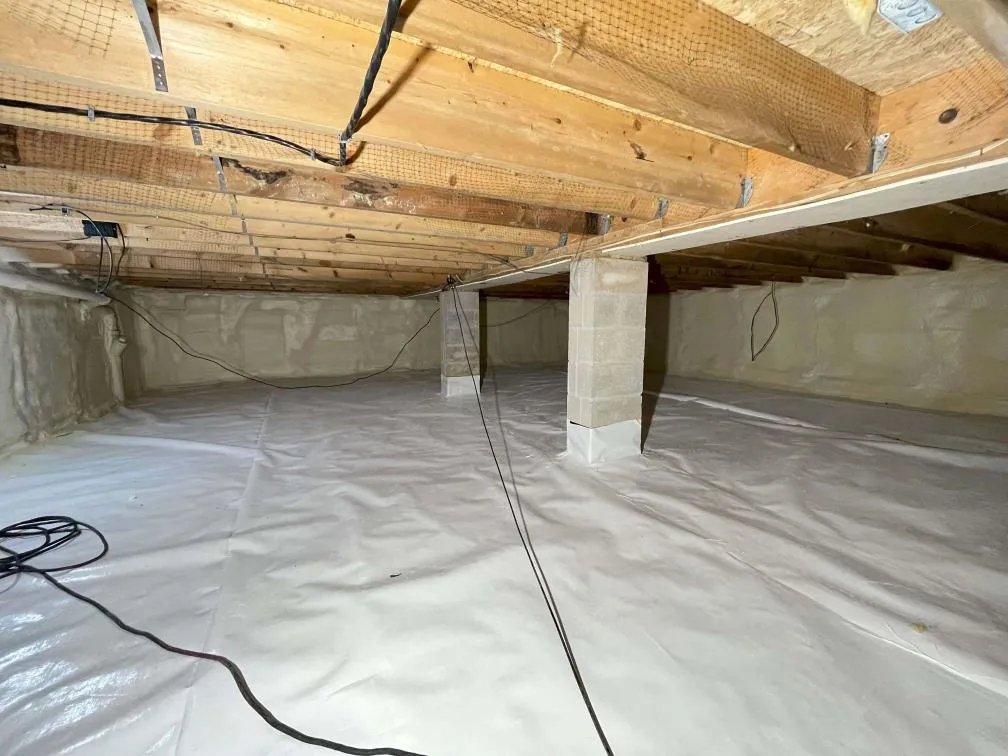
You look under the house and see plastic covering the ground.
Great. The crawl space has a vapor barrier.
But does that mean ground moisture is actually under control?
Not necessarily.
A crawl space vapor barrier only helps if it’s doing the job it was installed to do. If large areas of soil are exposed, seams have separated, the material has torn, or the installation leaves gaps around piers and other areas, moisture can still move from the ground into the crawl space.
That’s something Mold Patrol co-owner Brian Murphy sees regularly during inspections.
In Brian’s field experience, inadequate vapor barriers are extremely common in the crawl spaces his team inspects.
The important question isn’t simply, “Is there plastic under the house?”
It’s “Is the vapor barrier actually controlling ground moisture?”
- What Does a Crawl Space Vapor Barrier Actually Do?
- What Should a Proper Crawl Space Vapor Barrier Look Like?
- How Can a Crawl Space Vapor Barrier Fail?
- A Vapor Barrier Is Only One Part of Crawl Space Moisture Control
- How Often Should You Check Your Vapor Barrier?
- What If a Damaged Vapor Barrier Has Already Led to Mold?
- Think of the Vapor Barrier as Part of a System
What Does a Crawl Space Vapor Barrier Actually Do?
Soil underneath a home naturally contains moisture.
Some of that moisture can move upward into the crawl-space environment as water vapor. Once it’s there, it can contribute to elevated humidity, condensation, damp building materials, and conditions that support mold growth.
That’s where a crawl space vapor barrier comes in.
Brian explains it this way:
“The purpose of the vapor barrier is to keep moisture on the ground and to keep it from coming up through the natural process of evaporation or condensation and attaching to the underside of the home.”
Brian Murphy
In simple terms, the barrier separates the exposed earth from the air inside the crawl space.
The U.S. Department of Energy’s building-science guidance explains the same basic process: moisture can move from soil into a crawl space as liquid water or water vapor, where it may contribute to condensation and moisture problems on the structure above. Its guidance recommends a continuous polyethylene ground barrier as part of crawl-space moisture control.
You can read the Department of Energy’s crawl-space moisture guidance here.
That connection matters when mold is already present.
Brian’s approach to remediation starts with the idea that mold growth usually points to a moisture condition that also needs attention.
“Mold is the symptom. It’s not the cause. Right? So the cause is moisture.”
Brian Murphy
That’s also why understanding why mold keeps coming back matters. Cleaning growth from floor joists while allowing ground moisture to continue entering the crawl space can leave the underlying conditions unchanged.
If your crawl space has exposed dirt – or you’re not sure how complete the existing barrier is – have the moisture conditions evaluated before assuming the plastic that’s there is enough.
What Should a Proper Crawl Space Vapor Barrier Look Like?
One of the useful things about Brian’s interview is that he gets very specific about what Mold Patrol actually looks for.
“When a vapor barrier is adequately installed… all soil has to be covered. The seams have to be taped. It needs to be secured around the piers. There doesn’t need to be any exposed soil in the crawl space.”
Brian Murphy
Ground Coverage Matters
The barrier should do what its name suggests: create a barrier between ground moisture and the crawl-space environment.
That means looking for:
- good coverage across the crawl-space floor;
- seams that are properly joined;
- material fitted around piers and penetrations;
- areas where the barrier has shifted;
- gaps that leave soil exposed;
- tears or other damage.
This isn’t just Mold Patrol’s preference.
Current U.S. Department of Energy weatherization guidance calls for 100% ground coverage, or as close to it as reasonably possible. Its crawl-space vapor-retarder job aid also specifies a minimum 6-mil material, extending the material up walls, piers, and columns and overlapping seams.
See the Department of Energy crawl-space vapor-retarder guidance.
What Does “Mil” Mean?
When people hear “10 mil,” they sometimes assume it refers to millimeters.
It doesn’t.
Mil refers to the thickness of the material.
Brian says Mold Patrol commonly encounters general construction-grade vapor barriers around four to six mil thick. Mold Patrol’s own standard installation uses 10-mil material.
“The standard vapor barrier that we install is a 10 mil, and that’s a nice, good, strong, thick material.”
Brian Murphy
That’s Mold Patrol’s installation standard, not a statement that every crawl space is legally required to use 10-mil material.
The bigger point is durability.
A crawl-space barrier sits in an environment where technicians may walk across it, plumbing or HVAC work may take place, and the material needs to continue performing over time.
If you want to understand the bigger moisture picture underneath the house, our guide to crawl space moisture problems goes deeper into the other conditions Mold Patrol looks for.
If your vapor barrier covers only part of the ground or leaves large areas exposed around piers, walls, or penetrations, it may not be controlling moisture as effectively as you think.
How Can a Crawl Space Vapor Barrier Fail?
A vapor barrier isn’t something you install and then assume nobody ever needs to look at again.
Conditions change.
People go underneath the home.
Materials age.
Repairs happen.
Brian says Mold Patrol commonly finds barriers that are old and degraded, thinner than expected, torn, or separating at the seams.
That’s why condition matters just as much as initial installation.
“You want to make sure that your vapor barrier is intact, and there’s no seam separation or there’s no rips or tears.”
Brian Murphy
A plumber crawling across the space may accidentally damage the material.
An HVAC technician may need access to equipment or ductwork.
Something stored underneath the home may be dragged across it.
Or the barrier may simply have been installed poorly in the first place.
One small tear doesn’t automatically mean the entire crawl space has failed. But every opening exposes more soil and creates another place where ground moisture may enter the environment.
That’s why a crawl space vapor barrier should be thought of as a moisture-control component that needs occasional attention – not plastic you put down once and forget forever.
Where damaged barriers exist alongside visible mold, Mold Patrol’s crawl space mold removal and moisture control service looks at both the existing contamination and the conditions underneath the home. Mold Patrol’s current service information specifically identifies poor vapor barriers, humidity, drainage issues, and hidden leaks as common crawl-space moisture concerns.
If nobody has looked closely at your vapor barrier in years, an inspection can tell you whether the material, seams, and surrounding moisture controls are still doing their jobs.
A Vapor Barrier Is Only One Part of Crawl Space Moisture Control
This is where homeowners can end up spending money on one solution and expecting it to solve every moisture problem underneath the house.
A vapor barrier is important.
But it isn’t a magic sheet of plastic.
Brian describes crawl-space moisture control as a combination of systems:
“You’ve gotta have your vapor barrier. You’ve gotta have something to handle the humidity, and you have to have something to help with airflow.”
Brian Murphy
That distinction matters because ground moisture is only one possible source.
A crawl space may also have:
- plumbing leaks;
- drainage or exterior water intrusion;
- excessive relative humidity;
- condensation;
- a dehumidifier that isn’t operating correctly;
- a dehumidifier that isn’t draining properly;
- HVAC or ductwork issues.
A perfectly installed vapor barrier can’t repair a leaking pipe.
Likewise, a dehumidifier shouldn’t have to fight against uncontrolled water intrusion indefinitely.
Brian also sees homeowners close their crawl-space vents themselves in an attempt to create a sealed system.
His concern isn’t simply whether a crawl space is vented or closed. It’s when one part of the system is changed without dealing with everything else moisture-related.
“We see a lot of homeowners that will attempt to close their vents up themselves and create somewhat of a sealed system, but they’re not doing it correctly.”
Brian Murphy
That’s why how relative humidity affects mold growth and the wider issue of crawl space moisture both matter when evaluating a vapor barrier.
The DOE makes a similar building-science point: ground vapor control works as part of a broader approach that also considers bulk water, drainage, air movement, and other sources.
If someone tells you a vapor barrier alone will solve every crawl-space moisture problem, look at the whole space first. The right solution depends on where the moisture is actually coming from.
How Often Should You Check Your Vapor Barrier?
Most homeowners don’t spend their weekends crawling around beneath the house.
Fair enough.
But that’s also one reason problems can continue for years before anybody notices them.
Brian recommends having a crawl space professionally inspected roughly once a year.
That’s Mold Patrol’s professional recommendation, rather than a legal requirement.
“It’s generally good to have your crawl space professionally inspected at least once a year.”
Brian Murphy
During that kind of inspection, Brian says several things deserve attention:
- Are there any active leaks?
- Is the ductwork still properly attached?
- Is the vapor barrier intact?
- Have any seams separated?
- Are there rips or tears?
- If there’s a dehumidifier, is it operating properly?
- Is that dehumidifier actually draining correctly?
That last point is easy to overlook.
Installing moisture-control equipment doesn’t help much if the equipment fails and nobody realizes it.
Brian summarizes the goal well:
“As long as you have those systems in place and you stay on top of that… you stay clean, dry, and safe.”
Brian Murphy
The point isn’t to make you worry about the crawl space constantly.
It’s to find small changes before they turn into expensive problems.
And because HVAC equipment and ductwork commonly run through crawl spaces in homes Brian inspects around Burlington and Greensboro, our upcoming guide to HVAC moisture problems will look more closely at that relationship too.
If you don’t know when your crawl space was last checked, that’s a good place to start. You don’t need to wait for visible mold or a strong musty odor before finding out whether something has changed underneath the home.
What If a Damaged Vapor Barrier Has Already Led to Mold?
Repairing or replacing a damaged barrier helps address ground moisture.
But that doesn’t automatically remove mold that has already developed on floor joists, subflooring, insulation, or other materials.
You have two related issues:
What’s already contaminated, and what allowed that contamination to develop.
Both matter.
Brian says:
“Unless you’re correcting the conditions that cause it… it’s always going to come back.”
Brian Murphy
But the reverse is important too.
Correcting the moisture problem doesn’t make existing contamination disappear.
If visible mold is already established beneath the home, remediation may need to address the growth while moisture-control work reduces the chance of the same conditions developing again.
That source-focused approach is how Mold Patrol currently describes its crawl-space work for Burlington, Greensboro, and surrounding North Carolina communities.
If your vapor barrier is damaged and you’re already seeing mold beneath the home, Mold Patrol can evaluate both sides of the problem – the contamination that’s there now and the moisture conditions that need to change.
Think of the Vapor Barrier as Part of a System
A crawl space vapor barrier has one basic but important job:
reduce ground moisture entering the crawl-space environment.
For that to work well, coverage matters.
Seams matter.
The areas around piers matter.
Material condition matters.
And checking the system over time matters.
But the barrier is still only one part of keeping a crawl space dry.
Leaks, humidity, drainage, airflow, HVAC conditions, and dehumidification may all need consideration too.
Brian’s advice comes back to a simple prevention mindset:
“Frequent inspections are key to keeping small problems, small problems.”
Brian Murphy
For homeowners around Burlington, Greensboro, and nearby North Carolina communities, Mold Patrol can inspect your crawl space, vapor barrier, humidity, mold, dehumidification, and related moisture conditions and explain what actually needs attention.